MOTS-c
16-amino acid mitochondrial peptide encoded by the mitochondrial genome, studied in metabolism and longevity research. Pharmaceutical grade, HPLC purity >99%, COA available. Shipped from Canada. For research use only.
Description
MOTS-c: Pharmaceutical grade mitochondrial peptide for research
MOTS-c (Mitochondrial Open Reading Frame of the 12S rRNA-c) is a recently discovered mitochondrial peptide that has been of major scientific interest since its characterization in 2015. Peptivia Lab offers a pharmaceutical grade, HPLC-tested formulation, assembled and shipped from Canada for laboratory research.
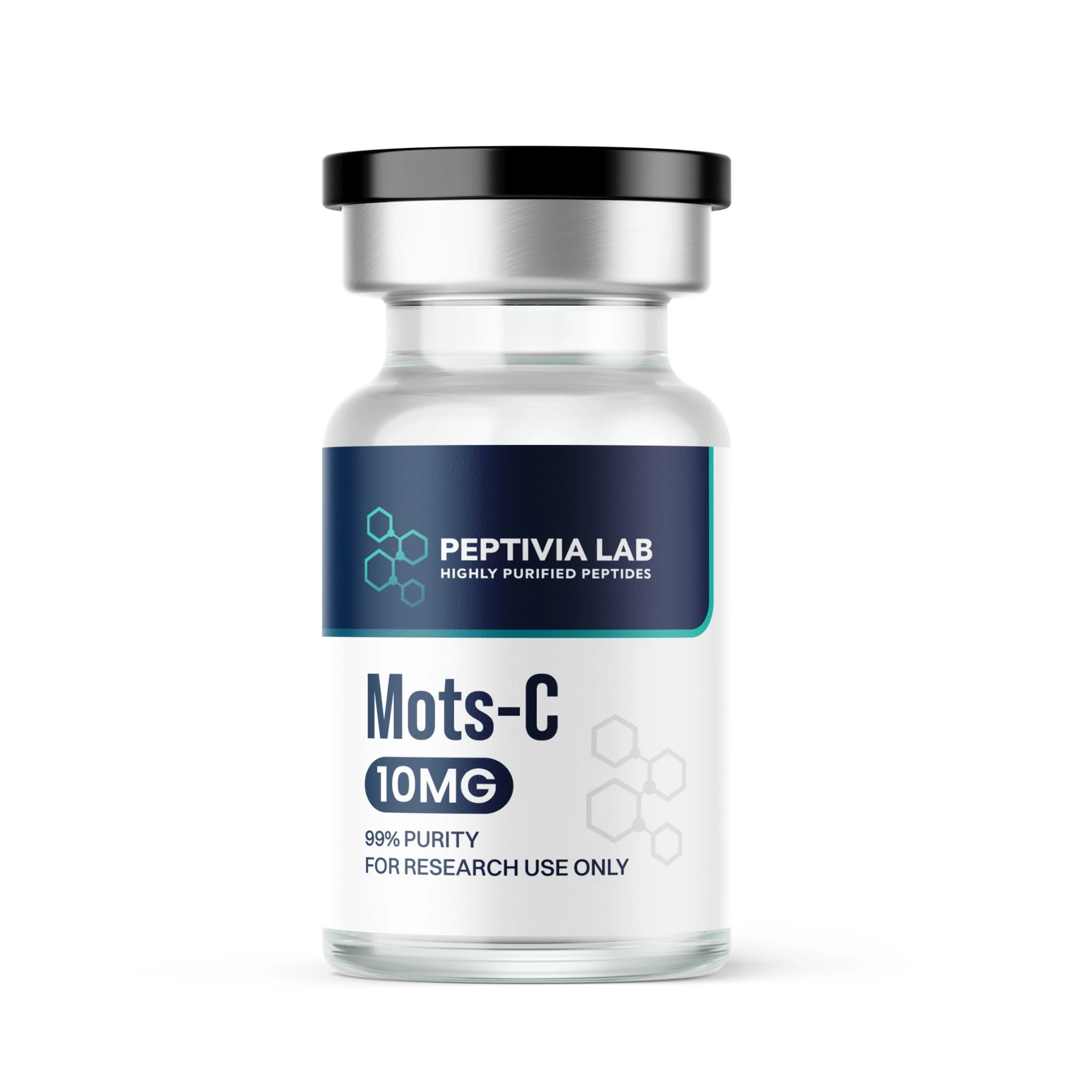
Each lyophilized vial comes with a Certificate of Analysis (COA) certifying a purity of over 99%.
What is MOTS-c?
MOTS-c is a 16-amino acid peptide encoded by a small open reading frame located in the mitochondrial MT-RNR1 (12S rRNA) gene. Unlike the vast majority of cellular proteins which are encoded by nuclear DNA, MOTS-c is one of the few peptides encoded directly by the mitochondrial genome, making it a unique object of research.
It was first characterized in 2015 by the team of Dr. Changhan David Lee and Dr. Pinchas Cohen at the University of Southern California (USC). Their publication in Cell Metabolism demonstrated the role of this peptide in the regulation of cellular metabolism and energy homeostasis.
Since then, MOTS-c has been studied as a mitochondria-to-nucleus retrograde signal, meaning it transmits information from the mitochondria to the cell nucleus in response to metabolic stress.
Mechanisms of action studied in research
Scientific literature documents several mechanisms of interest studied in vitro and in animal models:
- AMPK activation (AMP-activated protein kinase) — a central enzyme in cellular energy sensing, studied as the primary target of MOTS-c
- Regulation of folate metabolism and the methionine cycle, involved in energy production
- Mitochondria-to-nucleus retrograde signaling — nuclear translocation demonstrated under metabolic stress conditions (Kim et al., 2018)
- Modulation of nuclear gene expression in response to metabolic stress
- Glucose homeostasis — documented effects on insulin sensitivity in murine models (Lee et al., 2015)
- Lipid metabolism — studied role in adipose tissue homeostasis (Lu et al., 2019)
- Osteogenic differentiation — TGF-β/Smad pathway studied in mesenchymal stem cells (Hu & Chen, 2018)
These mechanisms are reported in scientific literature and are presented for informational purposes only, within a research context.
Research Areas
MOTS-c is the subject of active studies in several cutting-edge scientific fields:
- Research on mitochondrial-derived peptides (MDPs)
- Studies on cellular aging and longevity (Fuku et al., Reynolds et al.)
- Research on metabolic homeostasis and insulin resistance
- Studies on adipose tissue metabolism
- Research on age-related physical decline (murine models)
- Experimental cardiovascular studies (Qin et al., 2018)
- Research on bone health and osteogenesis (Hu & Chen, 2018)
- Studies on exercise and muscle metabolism
MOTS-c: A peptide encoded by mitochondria
What makes MOTS-c particularly unique in research is its origin: it belongs to the still little-explored family of mitochondrial-derived peptides (MDPs). This family also includes:
- Humanin — the first MDP discovered, studied in neuroprotection
- SHLP1-6 (Small Humanin-Like Peptides)
- MOTS-c — studied primarily for metabolism and longevity
The discovery of these peptides has opened a new field of research into mitochondria-to-nucleus communication and the regulatory role of mitochondria in global cellular physiology.
Technical specifications
- Available dosages: several formats in lyophilized vials (see options above)
- Purity: Over 99%, HPLC-tested
- Form: Lyophilized peptide (powder)
- Length: 16 amino acids
- Genomic origin: open reading frame of the mitochondrial MT-RNR1 gene (12S rRNA)
- Classification: mitochondrial-derived peptide (MDP)
- Certificate of Analysis (COA): Available upon request
- Packaging: Sealed glass vial, sterile handling recommended
- Origin: Pharmaceutical-grade peptide synthesis
Reconstitution and Storage
MOTS-c is provided in lyophilized form and must be reconstituted with bacteriostatic water (not included).
Before reconstitution: store the closed vial in the freezer (-20°C) for optimal long-term stability, protected from light.
After reconstitution: Store in the refrigerator (2-8°C). Use the solution within 60 days.
💧 Why bacteriostatic water? It contains 0.9% benzyl alcohol which inhibits bacterial growth, allowing for safer and longer preservation of your research peptide solutions. Read our complete guide to bacteriostatic water →
Why choose Peptivia Lab?
- Quebec-based company — based in Quebec, we ship across Canada with no customs issues
- Pharmaceutical grade — each batch is HPLC-tested
- Full traceability — Certificate of Analysis (COA) available
- Discreet delivery — neutral packaging, tracking provided
- Bilingual service — customer support in French and English
- Secure payment — Interac and bank transfers
Complementary peptides and coenzymes for your research
Researchers studying MOTS-c are often interested in other compounds involved in cellular metabolism and longevity:
- NAD+ — central coenzyme of energy metabolism, substrate for sirtuins
- GHK-Cu — research on cellular regeneration and gene modulation
- BPC-157 — research on tissue regeneration
Frequently Asked Questions (FAQ)
What exactly is MOTS-c?
MOTS-c (Mitochondrial Open Reading Frame of the 12S rRNA-c) is a 16-amino acid peptide encoded by the mitochondrial genome. It was characterized in 2015 by Dr. Changhan David Lee’s team at USC and is the subject of active research on metabolism, cellular aging, and mitochondria-to-nucleus signaling.
Why is MOTS-c considered unique?
MOTS-c is particularly interesting because it is one of the few peptides encoded directly by the mitochondrial genome rather than by nuclear DNA. It belongs to the mitochondrial-derived peptide (MDP) family, a recently discovered class that also includes humanin and SHLP1-6.
What is the difference between MOTS-c and NAD+?
These are two different molecules studied in the context of metabolism and longevity, but they have distinct natures. MOTS-c is a peptide (chain of amino acids) encoded by mitochondrial DNA. NAD+ is a nucleotide coenzyme involved in redox reactions. They are often studied together as they both play roles in mitochondrial metabolism.
Is MOTS-c legal in Canada?
The MOTS-c sold by Peptivia Lab is intended strictly for laboratory research. Our products are not approved by Health Canada for human or veterinary use. They are intended exclusively for scientific research.
How do I reconstitute my MOTS-c vial?
Add bacteriostatic water to the lyophilized vial using a sterile syringe. The amount of water depends on the desired concentration for your research protocol. Gently tilt the vial until completely dissolved (do not shake vigorously).
How long does reconstituted MOTS-c last?
Once reconstituted with bacteriostatic water, MOTS-c should be stored in the refrigerator between 2 and 8°C and used within 60 days. Before reconstitution, the freezer (-20°C) extends long-term stability.
Do you ship MOTS-c across Canada?
Yes, Peptivia Lab is a Quebec-based company that ships MOTS-c across Canada (Quebec, Ontario, Alberta, British Columbia, etc.) with discreet packaging and full tracking. Delivery times vary by province.
📚 Scientific References
Research on MOTS-c is documented in numerous major peer-reviewed publications, including:
- Lee, C., Zeng, J., Drew, B. G., Sallam, T., Martin-Montalvo, A., Wan, J., Kim, S. J., Mehta, H., Hevener, A. L., de Cabo, R., & Cohen, P. (2015). The mitochondrial-derived peptide MOTS-c promotes metabolic homeostasis and reduces obesity and insulin resistance. Cell Metabolism, 21(3), 443–454. https://doi.org/10.1016/j.cmet.2015.02.009
- Lee, C., Kim, K. H., & Cohen, P. (2016). MOTS-c: A novel mitochondrial-derived peptide regulating muscle and fat metabolism. Free Radical Biology and Medicine, 100, 182–187. https://doi.org/10.1016/j.freeradbiomed.2016.05.015
- Kim, K. H., Son, J. M., Benayoun, B. A., & Lee, C. (2018). The mitochondrial-encoded peptide MOTS-c translocates to the nucleus to regulate nuclear gene expression in response to metabolic stress. Cell Metabolism, 28(3), 516–524.e7. https://doi.org/10.1016/j.cmet.2018.06.008
- Reynolds, J. C., Lai, R. W., Woodhead, J. S. T., Joly, J. H., Mitchell, C. J., Cameron-Smith, D., Lu, R., Cohen, P., Graham, N. A., Benayoun, B. A., Merry, T. L., & Lee, C. (2021). MOTS-c is an exercise-induced mitochondrial-encoded regulator of age-dependent physical decline and muscle homeostasis. Nature Communications, 12(1), 470.
- Lu, H., Wei, M., Zhai, Y., Li, Q., Ye, Z., Wang, L., Luo, W., Chen, J., & Lu, Z. (2019). MOTS-c peptide regulates adipose homeostasis to prevent ovariectomy-induced metabolic dysfunction. Journal of Molecular Medicine, 97(4), 473–485. https://doi.org/10.1007/s00109-018-01738-w
- Hu, B. T., & Chen, W. Z. (2018). MOTS-c improves osteoporosis by promoting osteogenic differentiation of bone marrow mesenchymal stem cells via TGF-β/Smad pathway. European Review for Medical and Pharmacological Sciences, 22(21), 7156–7163.
- Mohtashami, Z., Singh, M. K., Salimiaghdam, N., Ozgul, M., & Kenney, M. C. (2022). Most recent mitochondrial-derived peptide in human aging and age-related diseases. International Journal of Molecular Sciences, 23(19), 11991. https://doi.org/10.3390/ijms231911991
⚠️ Warning – Research Use Only
The MOTS-c sold by Peptivia Lab is strictly intended for scientific laboratory research. This product is not a drug approved by Health Canada for human or veterinary use, and must under no circumstances be administered to humans or animals. Qualified scientific supervision is essential. By purchasing this product, you confirm that you are a qualified researcher or an authorized professional.
Reviews (0)
Total reviews
Persons recommended this product
Anonymous
Shopper
check_circle Verified
Shop owner replied
Anonymous
Shopper
check_circle Verified
Shop owner replied
There are no reviews yet.
Be the first to review “ ”
Thanks for your review!
Your feedback helps us improve our service.
Please log in to submit a review.