GHK-Cu Canada: Complete Guide to the Copper Peptide for Research
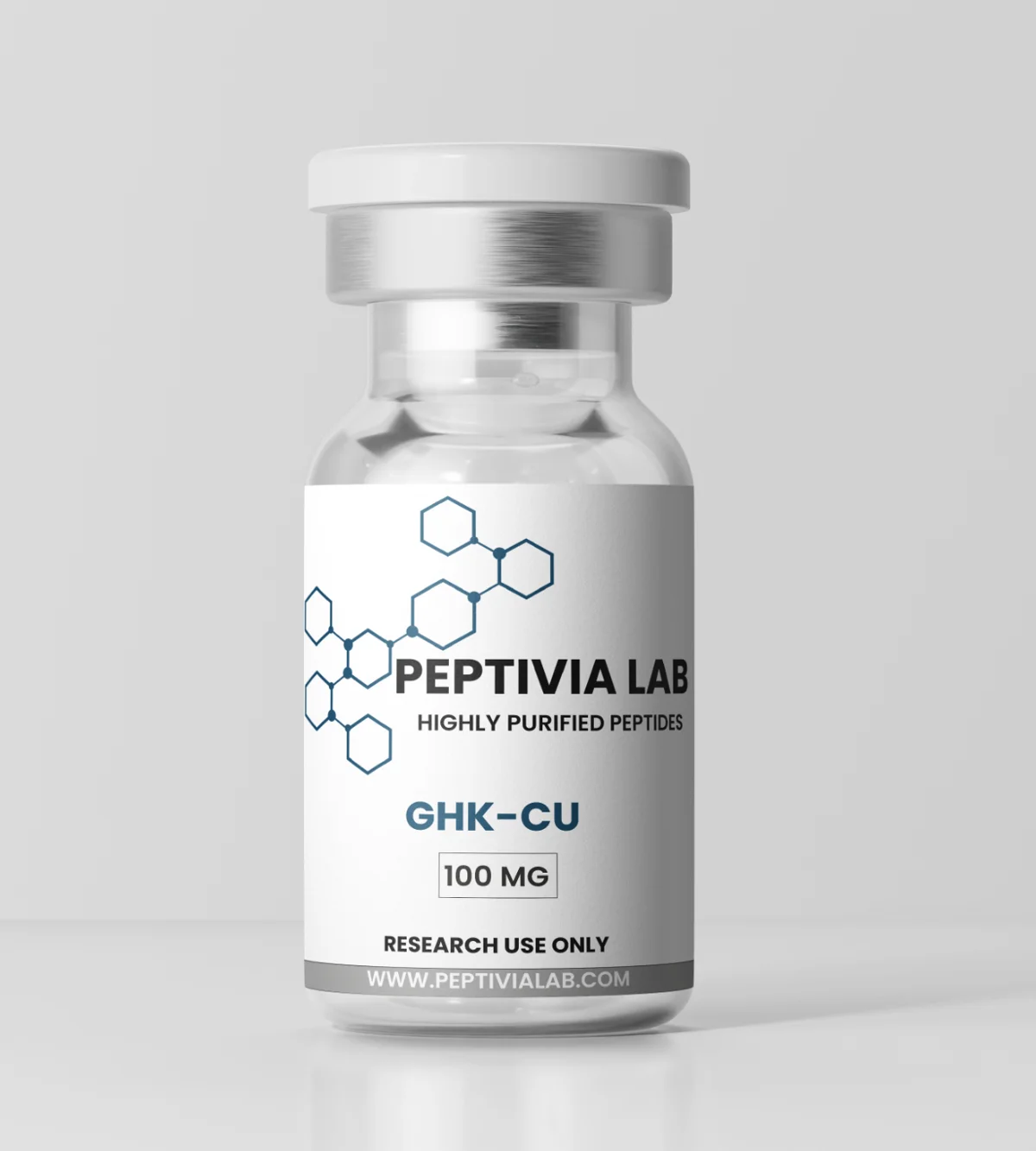
GHK-Cu (Glycyl-L-Histidyl-L-Lysine · Copper II) is one of the most fascinating natural peptides in the human body. This tripeptide—made up of only three amino acids—is naturally present in human blood plasma, saliva, and urine. Its distinguishing feature lies in its ability to form a stable complex with the cupric ion Cu²⁺, which gives it remarkable biological activity studied across many areas of cellular research.
Table of contents
Sequence: Gly-His-Lys · Cu²⁺ | MW: ~340 Da | Naturally occurring: plasma, saliva, urine | Available in 100 mg | Form: Powder
What is GHK-Cu?
GHK-Cu is a natural tripeptide with the formula Gly-His-Lys complexed with a copper (II) ion. With a molecular weight of approximately 340 Da, it is one of the smallest biologically active peptides known—yet its modest size contrasts with the breadth of its biological interactions documented in research.
GHK-Cu was first isolated from human plasma by Loren Pickart in 1973. Since then, hundreds of studies have documented its effects on fibroblasts, keratinocytes, stem cells, and many other cell types. Its plasma concentration decreases significantly with age—from ~200 ng/mL in young adults to ~80 ng/mL after age 60—making it a marker of interest in cellular aging research.
Cellular mechanism of action of GHK-Cu
1. Copper chelation and bioavailability
The Gly-His-Lys sequence has a very high affinity for copper (II), with an association constant of ~10¹⁷ M⁻¹. This binding forms a stable complex that protects copper from precipitation at physiological pH and facilitates its intracellular transport. The complexed copper is thus made bioavailable for copper-dependent enzymes.
2. Activation of lysyl oxidase
Lysyl oxidase is a copper-dependent enzyme essential for cross-linking collagen and elastin fibers in the extracellular matrix. By providing bioavailable copper, GHK-Cu supports this enzyme’s activity—a central mechanism in studies on collagen synthesis.
3. Activation of SOD (Superoxide Dismutase)
Copper/zinc superoxide dismutase (Cu/Zn-SOD) is one of the main cellular antioxidant systems. GHK-Cu facilitates copper loading of this enzyme, enhancing its ability to neutralize superoxide radicals O₂⁻.
4. Proteasome modulation
In vitro studies show that GHK-Cu stimulates proteasome activity—the enzymatic complex responsible for degrading oxidized and damaged proteins in cells. This mechanism is studied in the context of cellular aging and proteotoxic stress.
GHK-Cu research areas
Skin biology and fibroblasts
GHK-Cu is one of the most studied peptides in skin biology. In vitro studies on human dermal fibroblasts document its ability to stimulate the synthesis of collagen types I, III, and IV, as well as fibronectin and glycosaminoglycans—essential components of the dermal extracellular matrix.
Wound healing and tissue repair
Animal wound-healing models show that applying GHK-Cu accelerates wound closure, stimulates keratinocyte migration, and improves the organization of newly formed collagen fibers. These effects are attributed to its role in stimulating cell proliferation and attracting repair cells.
Hair research
GHK-Cu is studied for its effects on hair follicles. Studies in murine models and ex vivo follicle cultures examine its influence on follicular stem cells and the phases of the hair cycle (anagen, catagen, telogen).
GHK-Cu and gene modulation: a major discovery
One of the most remarkable findings about GHK-Cu is its impact on gene expression. DNA microarray analyses have shown that GHK-Cu modulates the expression of more than 4,000 human genes—about 31% of the human genome studied.
The regulated genes notably include genes involved in DNA repair, the antioxidant response (Nrf2 pathway), tumor suppression (p53), mitochondrial function, and inflammation regulation. This broad-spectrum gene-modulating capacity makes GHK-Cu a unique research tool in molecular biology.
Reconstitution and storage of GHK-Cu
Peptivia Lab’s GHK-Cu is available in 100 mg powder format. For reconstitution in an aqueous solution:
- Soluble in sterile water or bacteriostatic water
- Store the powder in the refrigerator between 2°C and 8°C
- Protect from light and moisture
- Reconstituted solution: store in the refrigerator; use within 20–30 days
Buy GHK-Cu Canada — Peptivia Lab
Peptivia Lab offers laboratory-grade GHK-Cu in 100 mg, shipped from Quebec.
- 100 mg format ideal for research
- 24–48h shipping across Canada
- Certificate of Analysis (COA) included
- French-language customer service
Frequently asked questions about GHK-Cu Canada
What is the difference between GHK and GHK-Cu?
GHK refers to the tripeptide alone (Gly-His-Lys) without copper. GHK-Cu is the complex of the tripeptide with the copper (II) ion. It is the complexed form, GHK-Cu, that exhibits most of the biological activities documented in the scientific literature.
Does GHK-Cu dissolve easily in water?
Yes, GHK-Cu is water-soluble and dissolves easily in sterile or bacteriostatic water at room temperature. The solution typically takes on a slight bluish tint characteristic of the cupric complex.
Can GHK-Cu be combined with other peptides in research?
GHK-Cu is often studied in combination with other peptides in research protocols on tissue regeneration. Peptivia Lab also offers BPC-157 and TB-500, which are frequently studied in similar contexts.